

6 Exercises You Should Avoid (and What to Do Instead)
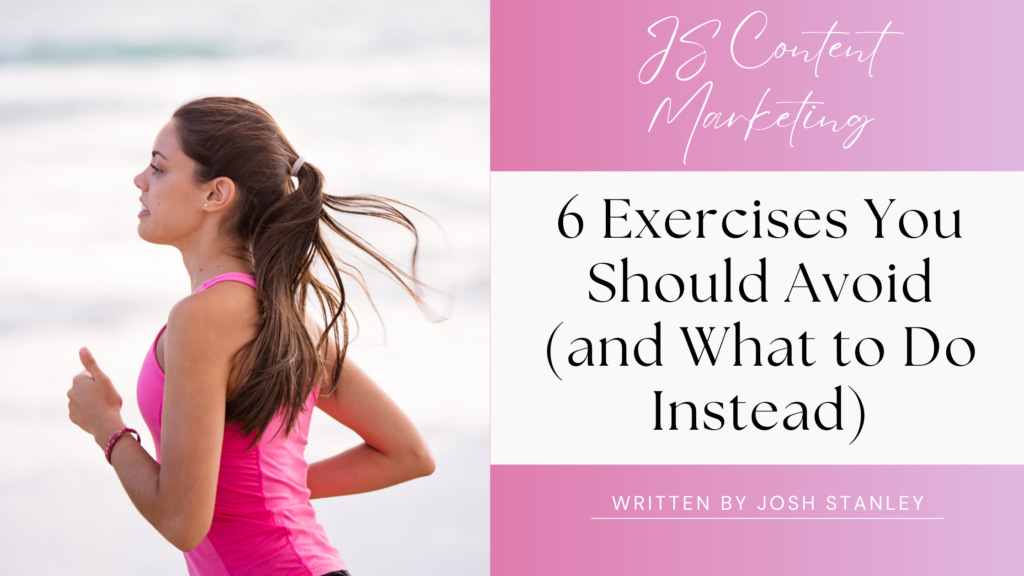
Not all exercises are created equal.
While many movements are designed to build strength, endurance, and mobility, some exercises do more harm than good—placing unnecessary strain on joints, increasing injury risk, or simply being ineffective.
Understanding which exercises to avoid and what to do instead can save you from pain and frustration while keeping you on track toward your fitness goals.
This article will explore six exercises that may be doing more harm than good and suggest safer, more effective alternatives.
Upright Rows: A Shoulder Injury Waiting to Happen
Many people have used the upright row in their workout routine. It’s done by holding weights at the waist, then raising them to the chin with the elbows coming up and the arms finishing at right angles.
Unfortunately, the angle of this exercise works against the body’s anatomy rather than with it. Bringing the arms up like this doesn’t provide the muscular activation of other exercises in the same category. What’s more, the stress coupled with internal rotation of the shoulders could lead to soft tissue damage or injuries to the rotator cuff.
What should you do instead? Simply alter your rows so you’re holding the weight in front of you with your arms straight at the beginning of the motion, then bring the weight toward you so your elbows come behind you as you complete the movement. This emulates the rowing motion of a boat much more accurately and works much better with the physics of your body.
Jogging: High Impact But Low Reward
Cardiovascular exercise should be a part of everyone’s workout routine. Getting your feet moving and racking up some steps is a sure way to improve endurance, blood pressure, and even mental health.
For many, jogging feels like the ideal middle ground—more intense than walking but sustainable for longer than running. But jogging’s intensity also means there’s a lot of strain on the joints. It doesn’t mean it’s terrible, it just means those interested in foot cardio are better off on one end of the speed spectrum or the other, rather than in the middle.
What should you do instead? Joggers should either walk or sprint. Walking is a fine form of exercise that’s gentle on the joints while providing a multitude of benefits. If you want to burn more calories, you’re better off sprinting than jogging, since the joint strain is about the same for both.
Behind-the-Head Exercises: More Strain for Less Gains
When it comes to classic exercises like the overhead press, which works the triceps and shoulders, or the pulldown, which works the biceps and back, many people look for ways to add variety and challenge.
While shifting the lift behind your head may seem like a way to increase tension, it’s the wrong kind of tension. Not only does this retract your shoulders into an awkward and injury-prone position, but it does so without providing any discernable benefits in terms of additional muscle activation.
What should you do instead? Simply bring these classic exercises back around to the front. There’s a reason these lifts find their way into so many programs. They are safe and effective, and, if you’re looking to add more challenge safely, these exercises are easy to overload.
Leg Extensions: Knee Strain and Unnatural Isolation
You know what they say about skipping leg day. While a strong base is vital for holistic wellness, along with balance and coordination, there are some popular leg exercises you should skip.
Leg extensions are often praised for their ability to isolate the quadriceps, but they place excessive strain on the patellofemoral joint, increasing the risk of knee pain and injury. Additionally, in real-world movements and athletic activities, the quads rarely work in isolation but instead share their load with the other muscles in your legs.
What should you do instead? Hit the squat rack. This movement allows your legs to work in a natural, biomechanically sound position, distributing the load across multiple muscle groups. Unlike leg extensions, squats engage the quads, hamstrings, glutes, and core simultaneously, improving overall strength and stability while reducing the risk of knee strain.
Sit-Ups: An Outdated Core Cruncher
Who hasn’t dreamed about having a washboard stomach? In their quest for the ever-elusive six-pack abs, most people’s first thought is to drop down and crank out some crunches.
However, these movements can strain the spine and neck, forcing the body into an unnatural curved position to complete the exercises. The repeated motion of sit-ups can also cause hip strain over time, meaning the sexy abs aren’t worth the strained joints.
What should you do instead? Rather than dropping to your butt for sit-ups, flip over for some planks. Balance on the tips of your toes and your forearms to engage in a safer exercise that activates the abs and other core muscles from a static position.
Dumbbell Flys on a Bench: A Shoulder Hazard in Disguise
Lying back on the bench for a set of dumbbell flys is a staple of many push-day routines. While this exercise aims to target the chest, it’s your shoulders that are at risk with this variation.
At the starting position of the lift, your shoulders are bearing a great deal of the weight and, unlike your back on the bench, are unsupported. This makes it difficult to overload the exercise for a heavy chest pump without jeopardizing your shoulders.
What should you do instead? Keep the flys, but ditch the bench. Put a towel on the ground and do your flys from this position where your shoulders aren’t hanging out in the air unsupported. Or, if it’s available, a classic fly machine works just as well.
Refine Your Routine for Better Gains and Better Health
By tweaking a few techniques and swapping some exercise selections, you can make every workout safer and more productive.
Safe and effective exercise is all about understanding the goal of the movements and how they impact the body. Sometimes all it takes is improved form, a new approach, or a more modern substitution to make your fitness routine better all around.
If you need content on exercise technique, nutrition, or other health and wellness topics, contact me today. As a copywriter and content marketer with a decade of experience, I’m as passionate about wellness as I am about the success of my clients.